Tennessee State Tigers men’s basketball is back.
Conference champions. NCAA Tournament team. A program resurrected after decades in the wilderness.
For years, Tennessee State basketball lived on the margins—far removed from the national conversation since the 1994–95 season. That changed this year. Not just because the Tigers won, but because they mattered again.
Picked to finish fourth in the preseason OVC poll, Tennessee State exceeded every expectation. The Tigers captured both the regular season and conference tournament championships, finishing 23–9 overall and 15–5 in league play—a program high for conference wins.
But let’s not confuse progress with arrival.
Tennessee State isn’t close. Not yet.
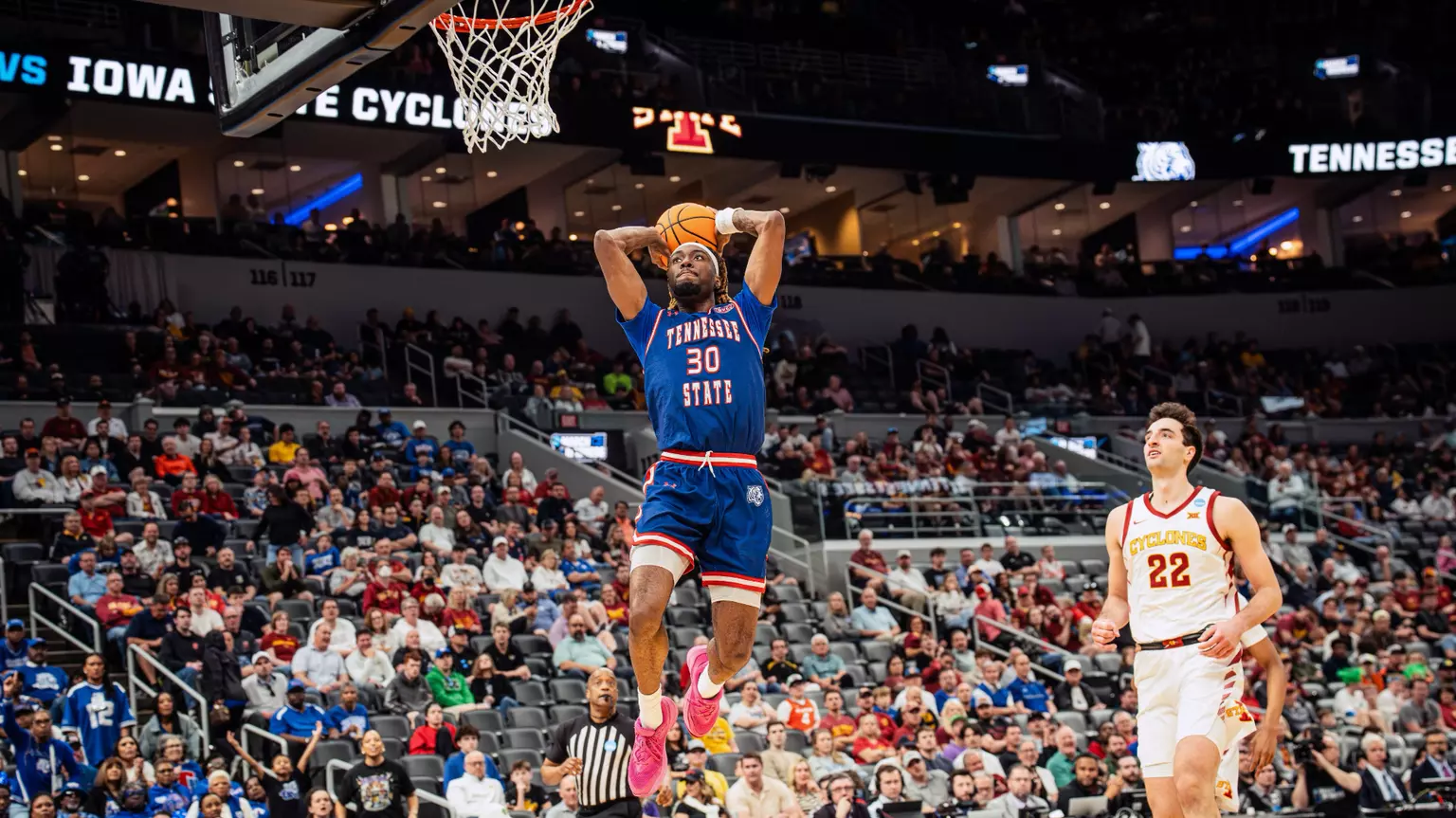
The loss to the Iowa State Cyclones men’s basketball didn’t just end the Tigers’ season—it exposed exactly where they stand in the college basketball hierarchy.
The very traits that fueled TSU’s dominance in the OVC—length, athleticism, and defensive versatility—were neutralized on the national stage. Against Iowa State, those advantages disappeared.
The Cyclones’ size and physicality flipped the script.
Iowa State controlled the glass, outrebounding Tennessee State 43–29, including an 18–11 edge on the offensive boards. They also owned the paint, outscoring TSU 48–40 inside.
When the game slowed down and became physical, Tennessee State didn’t have enough answers.
The issues can be boiled down simply:
They were smaller.
They were thinner.
They were overwhelmed.
And that’s okay.
Because now, there are no illusions.
This is what a real NCAA Tournament contender looks like. This is the level required—not just to participate, but to compete.
Programs like Iowa State aren’t just recruiting players—they’re building ecosystems. Depth isn’t accidental. It’s funded, developed, and sustained.
The gap is also financial.
Iowa State operates with an NIL budget estimated between $5–6 million. Tennessee State’s NIL efforts, led by the 1912 Sports Group Collective, surpassed $100,000 in its first six months as of December 2025.
That disparity shows up—in size, depth, and durability.
Still, the blueprint for Tennessee State is clear:
- Get bigger without sacrificing athleticism
- Add multiple knockdown shooters
- Build a bench that can withstand pressure
The need for size is non-negotiable. Against Iowa State, TSU’s lack of frontcourt presence was exposed as a critical weakness.
Perimeter shooting is another priority. The Tigers shot just 32.8% from three this season, limiting their ability to stretch defenses and create space.
And then there’s depth. When the starters rested, the drop-off was noticeable. At the NCAA Tournament level, that’s the difference between competing and surviving.
But the most important fix might not be schematic—it’s geographic.
Recruit like you belong.
Nashville is one of the most talent-rich cities in the region. For too long, Tennessee State has watched that talent leave for other programs.
That has to change.
If TSU is serious about taking the next step, locking down its backyard must become a priority, not an afterthought.
That’s where head coach Nolan Smith comes in.
Smith brings credibility that few coaches at this level can match. A national champion as a player with Duke and a former NBA guard, his pedigree instantly elevates the program’s profile.
More importantly, it opens doors.
Recruits who may have overlooked Tennessee State in the past are now at least willing to listen.
And that matters.
Because the next step for TSU isn’t just getting back to the NCAA Tournament.
It’s walking into March expecting to win.
As Smith said: “This is where we want to be. This is the expectation. These guys have set the bar extremely high.”
Right now, Tennessee State isn’t built for that.
But for the first time in a long time…
They’re built to get there.